Showing posts with label fmlxprmnt. Show all posts

Monday, January 5, 2015

7 Visionary Women Who Paved The Way For Electronic Music

7 Visionary Women Who Paved The Way For Electronic Music Part 1

1) DELIA DERBYSHIRE
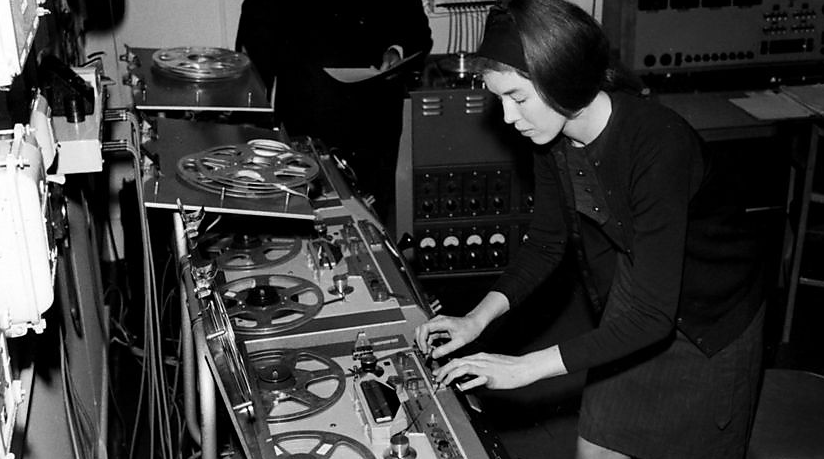
Delia Derbyshire
First we pay tribute to ‘Sculptress of Sound’ Delia Derbyshire. The ‘woman behind the wobbulator’ once approached Decca Recording Studios in London, only for them to tell her unequivocally that they did not employ women in their recording studios. Despite various companies knocking her back, she continued to pursue her passion, and in 1960 she landed an opportunity with the BBC as a trainee assistant studio manager.
A senior studio executive, Desmond Briscoe, soon realised the tall, quiet, auburn-haired Delia was not only enthusiastic, but enormously creative and talented. He invited her to join their experimental and innovative Radiophonic Workshop in 1962, where she was to stay for over ten years.
One of her first assignments was to realise one of the first electronic signatures ever used on television: Ron Grainer's score for the new science fiction series, Dr. Who. Delia, and her engineer, Dick Mills, had to create each sound from scratch; they were on the cutting edge, though Delia had no way of knowing how influential her work at the Radiophonic Workshop would become.

2) SUZANNE CIANI

SUZANNE-CIANI
An accomplished pianist, Suzanne composed scores for adverts—Coca-Cola and General Electric being among her clients—using a Buchla Analog Modular Synthesiser (which she bought with money earned working in Buchla's factory). Though best-loved for her original music and diverse soundscapes, her speciality was reproducing sound effects on the synthesiser that, prior to her work, engineers had difficulty recording properly.
The sound of a bottle of Coke being opened and poured, used in a series of radio and television commercials in the late 1970s, is one of Ciani's most widely recognized works. She soon found her sound effects to be in high demand. The pinball game ‘Xenon’ featured her voice and, in 1977, Ciani provided the sound effects for Meco's platinum-certified disco version of the Star Wars soundtrack.
In the early eighties, Ciani began to record New Age works which hybridised electronic and traditional instruments, and later she founded her own music label called Seventh Wave.

3) DAPHNE ORAM

DaphneOram
Though Daphne Oram was offered a place at the Royal College of Music, she instead chose to take up a position as a Junior Studio Engineer at the BBC. Here she began to experiment with tape recorders and explore the possibilities of synthetic sound. Following a trip to RTF studios in the 1950s, Oram campaigned for the BBC to provide electronic music facilities for use in its programming. This led her to set up the famous Radiophonic Workshop. A year later she opened ‘Oramics Studios for Electronic Composition’ in a building once used for drying oat near Kent.
In February 1962, Daphne won a large grant to support development of her Oramics machine. Making use of a new technique—best described as ‘drawn sound—this device allowed composers to draw an ‘alphabet of symbols’ on 8mm film and feed it through a machine to produce sounds on magnetic tape. Similar to the way we currently draw beats and manipulate sounds in software, this was the dawn of a visual, hands-on approach to electronic music making.
Here’s a virtual version of the machine currently on display at the Science Museum, London.

4) ELIANE RADIGUE

ELIANE RADIGUE
Paris-born Eliane Radigue’s most valued works (the products of an ARP synthesiser, a microphone, and looped tape recordings) saw praise throughout her career for their purity and for their contribution to the realm of sonic works. Hailed “a true original”, her soundscapes communicate moving, spiritual qualities, as though they have the power to transport a listener deep into the heart of sound.
After working at various universities and electronic music studios, Radigue travelled to Tibet in 1975 to explore Buddhism. While this move temporarily halted her creative output, you can hear the effect of her time spent in such quiet, peaceful surroundings, through the restraint and discipline used in the long, meditative drones she has created since.
A pioneer and musical visionary since she first began producing her haunting electronic sounds in the 1960s, Eliane Radigue has created a singular, powerful and unique body of work.

5) CLARA ROCKMORE

clara rockmore
A Theremin virtuoso and innovator, Clara Rockmore excelled in her violin lessons as a child. She travelled to Russia to attend the prestigious Imperial Conservatory of Saint Petersburg at only five years old (she remains, to this day, the youngest student ever to gain admittance to the institution).
In adulthood, however, Clara had to abandon the instrument; she had developed chronic bone difficulties as a result of childhood malnutrition. Contemplative about her creative future, she was led to the electronic Theremin, a new instrument, similar in sound to the violin; a sound she later described as “the saviour of her musical sanity”.
On noting the limits of the original Theremin design (having been accustomed to a violin’s more diverse qualities), Rockmore helped develop the instrument to fulfil her needs. She suggested several improvements to the instrument’s inventor, Léon Theremin—a faster volume antenna, wider musical range, and control over the instrument's tone—which he incorporated in later versions.

6) PAULINE OLIVEROS

pauline oliveros
Though she wrote her earliest music using traditional notation, Pauline Oliveros quickly began exploring tape and electronic music techniques. Influenced by her studies of Native American cultures and Eastern religions, her compositions introduced meditative and ritualistic practices while exploring deep, existential ideas.
Oliveros was a central figure in developing electronic art music, and a founding member of the San Francisco Tape Music Center. She has written books; imagined, nurtured and introduced new music theories; and examined new ways to focus attention on music. Most famous of all is her notion of ‘sonic awareness’ and ‘Deep Listening’. Oliveros herself coined the term 'Deep Listening' to describe the discipline of performing and recording in atmospheric, resonant and reverberant spaces such as caves, cathedrals and underground cisterns.

7) LAURIE ANDERSON

laurieanderson
In 1977, Laurie Anderson created a violin with magnetic tape on the bow (instead of the traditional horsehair) and a tape head in the bridge. Although she later got rid of the magnetic tape, and used the bow's contact to trigger audio samples, Anderson’s inventiveness, much like her voice-deepening vocal filter, is a recurring motif in her work.
Along with vocal filters, Anderson had her 'talking stick,' a long baton-like MIDI controller designed to reproduce sounds. She describes it like this:
*[The Talking Stick is] a wireless instrument that can access and replicate any sound. It works on the principle of granular synthesis – the technique of breaking sound into tiny segments, called grains, and then playing them back in different ways. The computer rearranges the sound fragments into continuous strings or random clusters that are played back in overlapping sequences to create new textures.”
The half-sung, half-spoken piece ‘O Superman (For Massenet)’, which makes use of her Talking Stick, unexpectedly rose to #2 on the UK Singles Charts in 1981.


7 Visionary Women Who Paved The Way For Electronic Music Part 2

1) WENDY CARLOS

Wendy Carlos
In 1953, Wendy Carlos won a scholarship at the Westinghouse Science Fair (now the Intel STS) for building her own computer. She was 14 years old.
She met Robert Moog ten years later, at the 1963 AES Convention, and quickly became a supporter of his work. She even suggested improvements to his synthesiser (such as touch-sensitive keys for better dynamic control).
We know Wendy best, however, for producing the first all-synth interpretation of classical music: an album of J.S. Bach pieces performed on a Moog synthesiser. Switched-On Bach both soured the palates of classical purists and captured the public’s imagination. As well as nudging electronic sound into the mainstream (winning three Grammys), the profits allowed her and Rachel Elkind to renovate a space in New York into a home and a recording studio.

2) LAURIE SPIEGEL

laurie spiegel
Laurie Spiegel’s groundbreaking work with computers in the 70’s and 80’s underpins the practice of many of today's bedroom producers. A curious and resourceful youngster, Laurie made her own early musical experiences; she taught herself the mandolin, guitar, and banjo by ear as a child, and music theory at 20.
After earning her Social Sciences degree in 1967, Spiegel stayed in Oxford and commuted to London to study guitar, theory and composition. She later moved to New York and went on to study composition at the Juilliard School, before moving to Brooklyn College to complete her MA in Music Composition.
With her graphical version of GROOVE (named VAMPIRE), Spiegel's aim was to synchronise the “composed functions of time,” both aural and visual. Instead of producing images to go with prewritten music, as had been done before, the system played sound and image off each other.
“I'd always had a little bit of synaesthesia and would often see colors and textures and shapes in some part of my visual imagination when listening to music. So I was looking for a system that could communicate and share those sensations, using the exact same data to generate the sound and the visuals."
Her most withstanding piece of computer software, "Music Mouse”, first emerged in 1986. It automates some aspects of the musical process (like tempo, vibrato, and volume), allowing the user to focus on improvisation and composition. Some of her works composed using the programme include ‘Cavis Muris’ (1986), ‘Three Sonic Spaces’ (1989) and ’Sound Zones’ (1990).
In fact, you can download the software yourself here.

3) BEBE BARRON

louis bebe barron
Bebe Barron’s work (with her husband Louis) defines one of the most essential tape music movements in history. A fresh-faced John Cage even produced his first work with magnetic tape (‘Williams Mix’) in their studio, under Bebe’s guiding encouragement. The Barron’s practice of layering manipulated sounds from several different tape machines can be seen today in the multi-tracking practices so fundamental to our recording studios.
Credited with writing the first electronic music for magnetic tape, the couple scored and engineered the world’s first all-electronic film score, for one of science fiction’s most highly regarded films, Forbidden Planet.
In an interview with Jane Brockman, Bebe beamed:
“The preview showing was one of our great experiences because they played the music directly off the magnetic tapes. They had synced up the projector and tape and they gave it so much volume it was embarrassing. It was so effective — they played it stereophonically, which they never did in those days. Then there was the landing of the space ship. That was one of the best cues in the picture — and the audience broke into spontaneous applause.”

4) JESSICA RYLAN

jessica ryan
An expert in circuitry, Jessica Rylan engineers and builds modular synthesisers to produce a diversity of sounds. Her synth-creations (see Personal Synth and Natural Synth) took inspiration from 1980s guitar pedals as well as 1960s and 1970s modular synthesisers.
Jessica uses her synthesisers in performances at installations, galleries and music venues, and sells them through her business Flower Electronics. She believes that making your own equipment or sourcing non-mainstream gear creates a more intimate connection to music, and describes her products as ones which “emphasise creativity, utility, durability, and freedom.”
Rylan credits her interest in schematics, circuit-building and electronics to her grandfather.
“[When I was five or six] we made a radio one time, a crystal radio, just the diode, no battery. He hooked this wire to a wire pipe in the ground, and then you’d listen with the earphone…”
~ (from Pink Noises: Women on Electronic Music and Sound, by Tara Rogers)

5) CARLA SCALETTI

carla scaletti
Carla Scaletti works as a lecturer at the CCMIX in Paris and is the co-founder of the Symbolic Sound Corporation (SSC).
Kyma, the SSC’s flagship invention, sees recognition for its revolutionary audio manipulation features and user-friendly application. Used by sound designers worldwide, it features in film soundtracks including Wall-E, Finding Nemo, War of the Worlds and Star Wars.
Synth pioneer Bob Moog spoke about Kyma in a report for Keyboard Magazine in 1987:
One new language that acknowledges no distinction between sound synthesis and composition is Kyma, a music composition language for the Macintosh that views all elements in a piece of music, from the structure of a single sound to the structure of the entire composition, as objects to be composed."
~ (from Platypus, Granules, Kyma, Daton, & the DSP56001 in Your Future, by Robert Moog)

6) JOHANNA BEYER   

johanna beyer
Born in Leipzig, Germany, most of Beyer’s learning and work came in the years following her emigration to the United States in 1923. A humble and passionate artist, she studied at the Mannes College of Music, receiving two degrees by 1928. She developed her skills in percussion (said to be her most fervent passion) at Henry Cowell’s percussion class at the New School for Social Research.
She was involved with the modernist and ultramodernist composers active in New York in the 1930s, a group which included electronic music pioneer John Cage. Cage himself performed two movements of her ’Three Movements for Percussion’ in his tours around the North-West during the late 1930s.
In 1936, her diverse range of skills came together in the ballet-play 'The Modern Composer'. She not only directed the project, but also wrote the lyrics, composed the music (performing its piano part) and choreographed, designed and created the costumes and the promotional material.
Her most famous work, composed in 1938, is the forward-thinking ‘Music of the Spheres’, written as part of a satirical opera entitled Status Quo. The frequency-shifting minimalist score is commonly thought to be the first of its kind written by a woman, though it was overlooked during Beyer’s lifetime.
Experimenting with the Ondes Martenot (an instrument which emerged just a decade earlier), ‘Music Of The Spheres’ was a compositional innovation. It showcased trembling, other-worldly sounds similar to those produced by a Theremin, with eerie oscillations, rolling drones, and wave-like chromatic harmonies (with an inspired triangle accompaniment!)

7) DORIS NORTON

doris norton
Back in the days when Apple Inc. was a mere seed, the company saw increasing potential in the marriage between computers and music. Spotting Norton’s inspirational vision to combine man, music and machine, Apple (along with Roland instruments) sponsored her debut album 'UnderGround'. This proved to be a catalyst for the career of one of the most important innovators of techno and electronic music.
Her subsequent releases (see: 'Parapsycho', 'Raptus', 'Nortoncomputerforpeace', 'Personal Computer', and 'Artificial Intelligence') saw Norton carving her name deeper into the field of technological and compositional fusion. In 1986, she became a consultant for IBM Computer Music, producing two records for the company: ’Automatic Feeling’ and ’The Double Side of Science’.
She began her musical journey on synthesisers such as Roland System 700, Roland System 100M and Minimoog, and credits her interest in early electronic music to innate curiosities about anthropology, biology, biochemistry and maths. Doris has explained the motivations behind her work, stating:
“In the beginning my main questions were [about] how music has control over biological equipment and [over] matter itself; how [the] brain receives, stores and processes music information and so on. My first solo albums were inspired by research I made on heart-rate sound, brainstorming and electroshock signals, psychic energy and mental phenomena . . . ”
~ (from Psychedelic Baby)

***
Source:  7 Visionary Women Who Paved The Way For Electronic Music Part 1 and Part 2
Contact the author
@esperscout and @fig_by_four

Tuesday, May 27, 2014

MoMA: Experimental Women In Flux [re-post]

Experimental Women In Flux
Selective Reading in the Silverman Reference Library
In 2009 The Museum of Modern Art acquired The Gilbert and Lila Silverman Fluxus Collection—a private collection devoted to the Fluxus art movement. Fluxus, with roots in experimental music, emerged in the United States and Europe in the early 1960s. With an emphasis on performance and play, Fluxus artists aimed to bring art and life together, collapsing the traditional divisions between mediums and undermining the authority of the artist through collaboration and audience participation. Along with artworks and the archives of The Gilbert and Lila Silverman Foundation, the acquisition includes the Silverman Reference Library, a collection of more than 1,500 artists’ books, exhibition catalogues, periodicals, and scholarly works, all of which are now held in the Museum’s library. These materials document the activities of artists integral to Fluxus and others on the periphery of the movement—precursors, contemporaries, and artists of succeeding generations whose artistic practices overlapped with Fluxus in group exhibitions, critical writing, and experimental magazines.
In this collection, which documents a range of avant-garde activities over several decades, networks of artists materialize in print. One conspicuous network is composed of women—the many female artists who helped shape Fluxus aesthetics and the numerous others associated with the group. Fluxus developed in the decade leading up to the women’s movement, and the prevalence of female participants in its diverse activities was unprecedented. The women featured in this exhibition created various forms of intermedia art—falling somewhere between visual art, poetry, performance, and sound art; they acted as interpreters of works by others and hosted seminal concert series that enabled avant-garde movements to flourish. In doing so they contributed to the expanding parameters of artistic expression that characterized their era while redefining “women’s work” for the female artist.
The exhibition is organized by Sheelagh Bevan with David Senior, The Museum of Modern Art Library.

Action & Performance in Print
Fluxus performance—concerned mainly with the interaction between human bodies and the objects and actions of everyday life—debuted in 1962 in a series of concerts across Europe organized by artist George Maciunas. The history of performance by Fluxus women as documented in the Silverman Reference Library is necessarily incomplete, giving only a partial view of the live, ephemeral, and durational work, which by its nature frustrates the limitations of print. The Library also touches on the roots of performance art and the contemporaneous existence of Nouveau Réalisme and Happenings—whose female participants’ contributions were largely unacknowledged, if not anonymous.
24 Stunden
[top of page] Ute Klophaus. Charlotte Moorman at the Galerie Parnass, Wuppertal, June 5, 1965. In 24 Stunden (Hansen & Hansen, 1965).
Moorman was the lone female participant in the twenty-four-hour Happening 24 Stunden (24 hours) in Wuppertal. The event’s organizers added Klophaus to the list of participants in the catalogue, blurring the line between documentation and participation.
Yves Klein. Anthropométrie. 1960. Serigraph and photo documentation. In KWY, no. 11. (1963).
Klein’s painting took on a performative element when he used nude women as “living paintbrushes,” making his Anthropométrie (Anthropometry) paintings in front of a seated audience.
Niki de St. Phalle, 1961. In Nouveau Réalisme, 1960/1970 (Rotonda della Besana, Comune di Milano, 1970).
St. Phalle initiated her own form of action painting in her Tir (Shooting) series of paintings. To make the works the artist and, later, her audience shot rifles at canvases prepared with bags of paint.
Patty Mucha. In Store Days: Documents from The Store, 1961, and Ray Gun Theater, 1962, ed. Claes Oldenburg and Emmett Williams (Something Else Press, 1967).
Happenings
Store Days
Mucha, shown here performing with Claes Oldenburg, also collaborated in sewing costumes and constructing objects and sets for Oldenburg’s Happenings and installations.
Charlotte Moorman. In 24 Stunden (Hansen & Hansen, 1965).
Moorman forged a unique career in the gray area between composer and performer created by the opportunities for individual interpretation in Fluxus compositions. She founded the Annual Avant Garde Festival (1963–80) in New York, bringing together Fluxus artists with experimental poets, artists, dancers, and musicians of all kinds.
VTRE
Shigeko Kubota, Yoko Ono, Mieko Shiomi, and Alison Knowles all collaborated on performance-based works that often took common activities as their material. These Fluxus artists believed that the acts of preparing food, marrying, smiling, playing games, or rustling a newspaper were forms of “social music,” making life itself a ready-made work of art. Solo performances by women were not always playful, however, and some took on more intimate or confrontational tones. Women involved in Fluxus have primarily characterized their experience in these events as liberating, as giving them a sense of artistic independence. However, the images of women in these early catalogues and magazines—all of which were edited by men—tell multiple, contradictory stories of artistic agency and vulnerability that feminists and art historians continue to debate.
Cut Piece [left] Yoko Ono. Cut Piece. 1965. In En Trance (Randers Kunstmuseum, 1990).
Ono, like Shigeko Kubota and Mieko Shiomi, was part of a community of Japanese experimental artists and musicians who found artistic independence in New York. In Cut Piece Ono signaled what was to become a life-long exploration of audience participation. In a gesture of interactive sacrifice she invited members of the public to cut her clothing with scissors.
[above] Shigeko Kubota. Vagina Painting. 1965. In VTRE, no. 7 (1966). Photographs by George Maciunas
In Vagina Painting, Kubota attached a red-paint-dipped brush to her underwear and moved her body to make marks on paper. The work, shown here in the official Fluxus newspaper VTRE, was later viewed as a proto-feminist statement, though Kubota herself denied this interpretation.
Lette Eisenhauer in Lick Piece, by Benjamin Patterson. 1964. In Happening & Fluxus: Materialen, ed. Hanns Sohm (Koelnischer Kunstverein, 1970). Photograph by P. Moore
Alison Knowles in Danger Music, by Dick Higgins. 1961. In Happenings, Fluxus, Pop Art, Nouveau Réalisme: eine Dokumentation, ed. Jürgen Becker and Wolf Vostell (Rowohlt, 1965).
Alison Knowles remained closely involved with Fluxus throughout the 1960s and ‘70s. She is shown here shaving the head of fellow Fluxus artist Dick Higgins, as she performs the final part of his five-word score:  "Hat. Rags. Paper. Heave. Shave."
“Lady Mystica” in Composition for Lines and Composition for Alarm Clocks, by Bob Lens. 1964. In Fluxus in Holland: the Sixties, ed. Harry Ruhé (Galerie A/artKitchen Gallery, 2009).
Monique Smit in Sun in Your Head, by Wolf Vostell. 1964. Photo by Igno Cuypers. In Fluxus in Holland: the Sixties, ed. Harry Ruhé (Galerie A/artKitchen Gallery, 2009).
Billie Hutching and George Maciunas. Flux Wedding (Money for Food Press, 1978). Photographs by Hollis Melton
Both the social and subversive elements of Fluxus informed the artistic presentation of the marriage of poet Billie Hutching and Fluxus organizer George Maciunas. The bride and groom each wore women’s gowns, then exchanged them at the altar. The photographs, marriage certificate, and guest registry were later published as a performance score.
Happening & Fluxus


Textual Scores and Instructions
For artists associated with Fluxus, the concepts, from music, of the score and the arrangement provided the structural basis of both performance and the methods of recording it. The Silverman Reference Library contains numerous scores and instructions for performances that expand on Fluxus artist George Brecht’s notion that music “isn’t just what you hear . . . but everything that happens.” These texts by women combine thought, perception, and imagination as equal parts in a multisensory music that relies on the reader for realization.
An Anthology
Simone Forti. [Dance Constructions]. In An Anthology, 2nd ed., ed. La Monte Young (H. Friedrich, 1970).
In the first publication to compile scores by members of Fluxus, the dancer Forti contributed instructions that could be performed by nondancers, realizing one of the group’s main tenets: anyone can create art.
[below] Alison Knowles. Journal of the Identical Lunch (Nova Broadcast Press, 1971).
This book documents Knowles’s daily lunch of a tuna sandwich at the Riss Diner in New York, while devoting more space to the subsequent “arrangements” performed by friends and fellow artists. She later expanded the work in a series of screen-prints, now on view in the museum’s Contemporary galleries, and will perform the work at MoMA in 2011.
Identical Lunch
Philip Corner. The Identical Lunch: Performances of a Score by Alison Knowles (Nova Broadcast Press, 1973).
Fluxus artist Philip Corner convinced Knowles to create a score from her daily meal, and later published his own book-length arrangement of the work.
Poesie et Cetera Americaine: Biennale Internationale des Jeunes Artistes (Musée d’art moderne de la ville de Paris, 1963).
Alison Knowles’s Shuffling Piece (for audience) and Simone Forti’s Instructions pour une danse were two of seven compositions performed simultaneously at the 1963 biennial for young artists in Paris. In the list of participants in the back of the program, les spectateurs (the spectators) were included along with the roster of artists.
Womens Work
Anna Lockwood et al. Womens Work (self-published, 1975).
This collection, edited by Alison Knowles and composer Annea Lockwood, was the first to bring together textual scores exclusively by women.
Yoko Ono. [Scores from Grapefruit]. In Yoko Ono: To See the Skies, ed. Jon Hendricks (Mazzotta, 1990).
Ono, an early advocate of the genre, has created, performed, and published event scores throughout her career. Her early collection Grapefruit (1964) was the first ever presentation of textual scores by a single artist in book form.
Spatial Poem
Mieko Shiomi. Spatial Poem (M. Shiomi, 1976).
Mieko Shiomi. Invitation to
Spatial Poem no. 4. 1975
Shiomi demonstrated the collaborative aspect of Fluxus and the group’s influence on developments in mail art in Spatial Poem (1965–75), a “global event” in which she enlisted artists through the mail to document their participation in her intimate action poems.
Esther Ferrer. Le Fil du Temps. In Esther Ferrer: Ekintzatik Objektura, Objektutik Ekintzara (Gipuzkoako Foru Aldundia, 1997).
One person sits on a chair. From the ceiling, a very fine thread starts falling. The person remains seated until the thread covers him/her completely.
Ferrer incorporates drawings and related installations into her texts. She often emphasizes the absurdity of life by including suicide as one possible outcome of her actions. An early member of the experimental music and performance group Zaj, based in Spain, Ferrer today remains committed to exploring the concept of performance in multiple mediums.
Katalin Ladik. Novi Sad (Projects). Wow, Special Zagreb Number, ed. Bosch + Bosch (1975).
Ester Ferrer
Ladik’s scores elicit reflections on and interventions into the physical environment of Novi Sad, Serbia. Ladik was the only female member of Bosch + Bosch, an art collective based in Subotica, Serbia, whose diverse activities touched on performance, Conceptual art, land art, sound art, and visual poetry.

Visual Music
Graphic notation—the use of symbols, images, and texts to transcribe music—emerged in the middle of the twentieth century, as composers began to investigate the borders between musical notation and visual art. For Fluxus artists, many of whom had been classically trained in the field, music served both as a mode of composition and a medium of sound and visual art. Producing works that employ combinations of drawing, calligraphy, texts, and collage, women created their own systems of notation. Other women artists in dialogue with the group worked closely with composers to interpret or enhance music through the traditional mediums of painting, sculpture, and photography. Male composers inserted the female body into new types of symphonic scores as a compositional element, but this objectification was countered by the prolific production of women—a small selection of which appears here.
As It Were Detail
Mieko Shiomi. As It Were Floating Granules (Japan Federation of Composers, 1976).
Shiomi was a cofounder of the Japanese experimental music collective Group Ongaku, with which she collaborated before and after her Fluxus years in New York. This six-part work—a chance composition for vocal groups and instrumentalists—employs a range of graphic notational systems and texts in English and Japanese.
Mieko Shiomi. Lyric Suite (Self-published, c. 1973).
This is one of six collages in Shiomi’s visual music portfolio Lyric Suite. More than any other female member of Fluxus, Shiomi, in her work as composer, visual artist, and performer, repeatedly returns to music as a ground for experimentation.
Lines
Marian Zazeela. Lines. In Selected Writings, Copyright © La Monte Young and Marian Zazeela 1969 (Heiner Friedrich, 1969, Munich)
Zazeela’s use of systems of abstract calligraphy in her work in the early 1960s is evidenced by the posters and cover art she designed for Young, a composer. As their close collaboration progressed, Zazeela inflected these inscriptions with color, expanding them into innovative light installations that formed an integral part of Young’s musical performances.
Dora Maurer. Time Pieces. In Source, no. 11 (1972).
Maurer, a filmmaker and visual artist, used photography and a language of time to depict the underlying structure of music. This work appeared as part of an exhibition-in-print on contemporary approaches to music, published in the avant-garde music magazine Source.
Alison Knowles. Blue Ram. 1967. In Notations, by John Cage (Something Else Press, 1969).
Knowles helped to design and edit Cage’s compilation of new musical scores. Her own contribution to the collection is a composition involving four performers, sound-making objects, and six illustrated cards.
Stimmung
Mary Bauermeister. Peng-cil. 1966. In Stimmung, für 6 Vokalisten, nr. 24, by Karlheinz Stockhausen (Universal Edition, 1969). Library copy
Bauermeister’s Cologne atelier was a center of experimental music for the European and American avant-garde, some of whom became involved with Fluxus. Bauermeister’s approach to painting inspired Karlheinz Stockhausen, the electronic-music composer, and their work was exhibited together in multimedia exhibitions. As part of the score for Stockhausen’s musical play Originale (1961), Bauermeister painted onstagea feat she later repeated alongside Fluxus artists at Charlotte Moorman’s Annual Avant Garde Festival.
Nam June Paik. Symphony no. 5. 1965. In Happenings, Fluxus, Pop Art, Nouveau Réalisme: eine Dokumentation, ed. Jürgen Becker and Wolf Vostell (Rowohlt, 1965).
Mieko Shiomi. Selections from Fluxus Suite: A Musical Dictionary of 80 People around Fluxus
(? Records, 2002).
Shiomi composed musical portraits of eighty figures associated with Fluxus. These selections represent Jean Brown, Esther Ferrer, Alice Hutchins, Alison Knowles, Shigeko Kubota, Barbara Moore, Charlotte Moorman, Pauline Oliveros, Yoko Ono, Takako Saito, Carolee Schneemann, Mieko Shiomi, and Marian Zazeela

Forms of Writing
For women artists associated with Fluxus, language was a site of aesthetic inquiry and play. The textual elements of many Fluxus artworks led to their inclusion in literary collections and underground magazines at a time when American art magazines did not devote much space to the group. In the little magazines of the 1960s and 1970s, work by Fluxus writers is presented beside work by the Beats, new poets of San Francisco, New York, and England, and visual poets from around the world, some of whom were also exploring the use of sound, images, and new technology in language arts.
Language Box
Bici Hendricks. Language Box, Box Language (Black Thumb Press, 1966).
Nye Ffarrabas, known then as Bici Hendricks, has described her book as a game without rules, invoking the “serious play” of children, who need no instructions to use a sandbox but simply start digging. The reader initiates his or her own process of creative synthesis, choosing to manipulate, arrange, define, or ignore the words printed on each side of the cards.
Seng Ts’an. Hsin hsin ming. Calligraphy by Takako Saito, translated by George Brecht, Albrecht Fabri, and Robert Filliou (Lebeer Hossmann, 1980).
Hsin hsin ming
The collaborative nature of Fluxus and its members’ shared interest in Zen Buddhism found a linguistic outlet in this polyglot translation of Seng Ts’an’s seventh-century writings on Chinese Buddhism, for which Saito provided the calligraphy in k’ai shu style.
Tamara Janković. Šesta Dimenzija 16 and Šesta Dimenzija 17. In Signal, no. 1 (1970).
Šesta Dimenzija 16 and Šesta Dimenzija 17
Janković was a member of the Belgrade-based Signalist group of experimental poets in the early 1970s and was on the editorial board for the group’s magazine, Signal. Her use, here, of numbers, letters, and the Pierre Cardin logo reflects the Signalist goal to explore symbols and imagery in new poetry that transcends national languages.
Carolee Schneemann. Meat Joy Notes as Prologue. In  Some/thing 1, no. 2 (1965).
Schneemann created a new, bilingual work from her notes to her stage performance Meat Joy with this playful technique: “The French text was made from a dictionary and a picture book, Look and Learn, then collaged and superimposed on the English, along with the sound of a ticking clock.”
Calligraph
Mary Beach. Concrete poem. In The San Francisco Earthquake 1, no. 3 (1968).
Beach’s calligraphs, Concrete poems, and experimental prose circulated along with works by Carol Bergé, Diane di Prima, and Diane Wakoski in the network of publications in which Fluxus, Beat poetry, and other underground writing converged.
Visual Poem (Untitled)
Lourdes Castro and Emilio Villa. Visual Poem (Untitled)In Da-a/u dela, no. 1 (1966).
To this collaboration with Villa, an Italian experimental poet, Castro contributed male and female silhouettes whose ambiguous embrace invites the reader to interpret Villa’s symbols above. Castro was a coeditor of the artists’ magazine KWY, which published poetic and visual works by Fluxus artists.
Yvonne Rainer. Three Distributions. In Aspen, no. 8 (1970-71).
Rainer, a dancer and filmmaker, transcribed movement using text, graphic diagrams, and images of bodies in her contribution to the Fluxus issue of Aspen.

Mediating the Body
Fluxus performers staged their bodies in social, interactive spaces, drawing attention to everyday tasks, movements, and objects. Women artists who made explicit and erotic uses of their bodies in their work sometimes sensed disapproval from the group. Shigeko Kubota recalls that her fellow Fluxus artists were visibly displeased by the graphic nature of Vagina Painting (1965), while Carolee Schneemann became alienated from Fluxus organizer George Maciunas following the productions of her sensual stage show Meat Joy (1964). Fluxus women and those on the periphery of the movement continued to investigate the body in different mediums, exploiting the immediacy of performance and the more distanced confrontations enabled by visual art, the book arts, and video. These exhibition catalogues and artists’ books document some of these uses of the naked female form.
Nude Descending a Staircase Video Sculptures
Shigeko Kubota. Nude Descending a Staircase. 1975–76. In Shigeko Kubota: Video Sculptures, ed. Zdenek Felix (Museum Folkwang Essen, 1981).
Following her early Fluxus performances and objects, Kubota began the pioneering career in video art and installation in which she continues to investigate the landscapes of the body and the natural world. In this homage to her mentor Marcel Duchamp, Kubota deconstructs the moving body of filmmaker Sheila McClaughlin to produce a new iteration of Duchamp’s painting of the same title.
Carolee Schneemann. Meat Joy (1964) and Fluxus (1990). In Ubi Fluxus Ibi Motus: 1990–1962, ed. Achille Bonito Oliva (Mazzotta, 1990).
Fluxus can be lots of fun when the boys let you on their boat / sometimes they throw you off the boat. / . . .
/ if you dont wear underpants or show your pussy you get pushed / over the side.
Schneemann’s explorations of eros in her maverick stage performances pioneered the American genre called body art. In this catalogue for a 1990 Fluxus exhibition, Schneemann paired sensuous imagery from Meat Joy with a retrospective statement about the group.
Friederike Pezold. Die Schwarz-Weisse Göttin und ihre Neue Leibhaftige Zeichensprache (Staatliche Kunsthalle, 1977).
Pezold’s early artists’ books, published by Reflection Press (run by Fluxus participant Albrecht d.), address issues of women in art in the early 1970s. In later performance, film, writings, and visual art Pezold reduced the female body to abstract hieroglyphics and often recomposed these elements in photographic installations and video sculptures.
Die Schwarz-Weisse Göttin und ihre Neue Leibhaftige Zeichensprache
The Story of Bern, or Showing Colors
Dorothy Iannone. The Story of Bern, or Showing Colors (Dieter Roth and D. Iannone, 1970).
Iannone takes as her subject the interrelations of love, sex, and spirituality. Although she is not viewed as a full member of the group, Iannone contributed to Fluxus publications and formed part of a social circle that included artists Emmett Williams and Dieter Roth. At a 1969 exhibition in Bern, her explicit imagery of male and female genitalia was censored. Roth withdrew his works from the show in protest and the gallery’s director, Harald Szeemann, resigned. Iannone processed the experience in this artist’s book, which illustrates the scandal in detail.
Helen Chadwick. Of Mutability (London Institute of Contemporary Arts, 1986). Library copy
Chadwick was part of the vibrant Fluxus community in England in the early 1970s. In these blue photocopied collages Chadwick refers to Edmund Spenser’s Renaissance verses on the forces of flux and entropy inherent to the universe, depicting her own body within an amniotic environment of decaying organic matter.
Opera Sextronique
Charlotte Moorman. Flyer for Opera Sextronique. In The World of Charlotte Moorman Archive Catalog, ed. Barbara Moore (Bound & Unbound, 2000). Library copy
Moorman used her body as a “living sculpture,” often performing in various states of undress and costume. After removing her bikini top at a 1967 performance of Opera Sextronique in New York—one of her many collaborations with Nam June Paik—she was arrested, charged, and given a suspended sentence for lewdness, becoming known in the media as “the topless cellist.”
Kate Millet. Sexual Politics (Doubleday, 1970).
Fluxus artist Kate Millet combined cultural and literary criticism in a work that became an important text for the developing fields of women’s studies and feminist theory.

Book-making
The emergence of artists’ books toward the end of the 1960s is inextricably linked to Fluxus and the Museum Library. Members of the group contributed to the early production of printed matter, which helped to set the stage for later developments in the genre. The women artists featured here created—and continue to create—conceptual, poetic, and narrative works, books as sculptural installations and as objects, and are also printers, publishers, editors, book dealers, and archivists. When the Silverman Reference Library was acquired, copies of some of its works were already in different sections of the Library—many in the Grapefruit
Franklin Furnace Artists’ Books Collection—revealing intersections among collecting practices that speak to the influence of Fluxus on the contemporary book arts and the institutions dedicated to preserving the book as a work of art.
Alison Knowles. The Big Book. In Décollage, no. 6 (1967).
Knowles’s walk-through installation The Big Book included objects and images of daily living—a saucepan, a telephone, a toilet—within a three-dimensional framework of eight-foot “pages.” Knowles’s work is performative in function, inviting bodies to experience the space in time, through their own, indeterminate “readings.”
Peter Moore. The Big Book, by Alison Knowles. c. 1967. Franklin Furnace Artist Files. © Estate of Peter Moore / VAGA, New York
Takako Saito. Die Chinesisch Tusch Zeichnungen auf dem Düsseldorf Wasser (Noodle Edition, 1985).
Saito Cover
A prolific artist of sculptural book forms and book objects, Saito suggests the melancholy of self-exile through the daily detritus of used coffee filters, connecting her Asian origins to the country in which she lives by combining Chinese ink with German water.
Door to Door
Helen Chadwick and David Mayor. Door to Door (Beau Geste Press, 1973).
In Croydon, two doors face each other across a lawn.
The contesting pagination in Chadwick and Mayor’s conceptual photobook draws the reader simultaneously backward and forward through the book. Chadwick’s figure, captured from near and far, parallels this spatial disorientation by seeming to magically move from one distant doorway to another.
Barbara Moore. Cookpot (ReFlux Editions, 1985). Reproduction of cover image supplied by B. Moore, 2010.
Individual personalities and practices inflect each contributor’s notion of what constitutes cooking in Moore’s collection of recipes by friends and fellow artists. Carolee Schneemann, for example, prescribes multiple roles for one cantaloupe: dried beads for children, food for cats, material for a facial, and, finally,
a high-protein breakfast.
Angel
Simone Forti. Angel (Self-published, 1978). Franklin Furnace Artists’ Books Collection
Forti’s book of short prose poems and photographs produces a nonlinear narrative of thought and memory that reflects the artist’s changing engagement with her work and life.
Lourdes Castro. D’Ombres (G. Schraenen, 1974). Franklin Furnace Artists’ Books Collection
Using a combination of colored sheets, vellum, and transparent covers, Castro used photographs from her Théâtre d’Ombres project as the basis for this screenprinted artist’s book. Her silhouetted figure, almost indistinguishable from the shadowy objects around her, suggests both presence and absence.
As she moves through the book, Castro’s form “comes to life” even as it appears to dematerialize in front of the reader’s eyes.

Citations (from top) and Additional Texts

Charlotte Moorman at 24 Stunden, a Happening at Galerie Parnass, Wuppertal, 1965. In 24 Stunden (Hansen & Hansen, 1965). Photograph by Ute Klophaus
24 Stunden. Hansen & Hansen, 1965
Happenings, Fluxus, Pop art, Nouveau Réalisme: eine Dokumentation, ed. Jürgen Becker and Wolf Vostell (Rowohlt, 1965)
Store Days: Documents from The Store, 1961, and Ray Gun Theater, 1962, ed. Claes Oldenburg and Emmett Williams (Something Else Press, 1967)
Shigeko Kubota. Vagina Painting. 1965. In VTRE, no. 7 (1966). Photographs by George Maciunas
Yoko Ono: En Trance, tilrettelagt af Jon Hendricks og Birgit Hessellund (Randers Kunstmuseum, 1990)
An Anthology, 2nd ed., ed. La Monte Young (H. Friedrich, 1970)
Alison Knowles. Journal of the Identical Lunch (Nova Broadcast Press, 1971)
Womens Work, ed. Anna Lockwood and Alison Knowles (Self-published, 1975)
Mieko Shiomi. Spatial Poem (Self-published, 1976)
Esther Ferrer: Ekintzatik Objektura, Objektutik Ekintzara. Gipuzkoako Foru Aldundia, 1997. Promotional postcard
Mieko Shiomi. As It Were Floating Granules (Japan Federation of Composers, 1976)
Marian Zazeela. Lines. In Selected Writings, Copyright © La Monte Young and Marian Zazeela 1969 (Heiner Friedrich, 1969, Munich)
Karlheinz Stockhausen. Stimmung, für 6 Vokalisten, nr. 24 (Universal Edition, 1969)

Bici Hendricks. Language Box, Box Language (Black Thumb Press, 1966)
Seng Ts’an. Hsin hsin ming. Calligraphy by Takako Saito, translated by George Brecht, Albrecht Fabri, and Robert Filliou (Lebeer Hossmann, 1980)
Tamara Janković. Šesta Dimenzija 16. In Signal, no. 1 (1970)
Mary Beach. Concrete poem. In The San Francisco Earthquake 1, no. 3 (1968)
Lourdes Castro and Emilio Villa. Visual Poem (Untitled). In Da-a/u dela, no. 1 (1966)
Shigeko Kubota: Video Sculptures, ed. Zdenek Felix (Museum Folkwang Essen, 1981)
Friederike Pezold. Eine Frau Reflektiert die Situation der Frau : Viva Vagina (Reflection Press, 1973)
Dorothy Iannone. The Story of Bern, or Showing Colors (Dieter Roth and D. Iannone, 1970)
Flyer for Opera Sextronique. In The World of Charlotte Moorman Archive Catalog, ed. Barbara Moore (Bound & Unbound, 2000).
Yoko Ono. Grapefruit: a Book of Instructions. Simon and Schuster, 1970
Takako Saito. Die Chinesisch Tusch Zeichnungen auf dem Düsseldorf Wasser (Noodle Edition, 1985)
Helen Chadwick and David Mayor. Door to Door (Beau Geste Press, 1973)
Simone Forti. Angel (Self-published, 1978)

Further Reading
Fluxus, etc.: the Gilbert and Lila Silverman Collection, ed. Jon Hendricks. Bloomfield Hills, Mich.: Cranbrook Academy of Art Museum, 1981.
Hannah Higgins. Fluxus experience. Berkeley: University of California Press, c2002.
Ubi Fluxus Ibi Motus, 1990-1962, ed. Achille Bonita Oliva. Milano: Mazzotta, 1990.
Women & Fluxus: Toward a feminist archive of Fluxus, ed. Midori Yoshimoto. Special issue of Women & Performance: a journal of feminist theory, vol. 19, no. 3 (2009).
Midori Yoshimoto. Into Performance: Japanese Women Artists in New York. New Brunswick, NJ: Rutgers Univ. Press, 2005.
All material in this exhibition is held by The Museum of Modern Art Library. Contact library@moma.org for an appointment.

Acknowledgements

Special thanks to Jon Hendricks, Barbara Moore, Mieko Shiomi, Ute Klophaus and Armin Hundertmark.
Also thanks to Rebecca Roberts, Sara Bodinson, David Hart, Julianna Goodman, Chiara Bernasconi, Jessica Nutting, Roberto Rivera, Robert Kastler, Thomas Griesel, Charlie Kalinowski, Milan Hughston and the entire MoMA Library staff.
(((SOURCELINK)))